The short answer
Single doors are usually 8 or 9 feet wide, doubles 16 feet, and most are 7 feet tall. Sizes are written width first.
An 8-foot-tall door gives roof racks and pickups more room, but it needs more headroom and a longer opener rail.
Measure the finished opening, then headroom, side room and backroom, since those decide which track and springs fit.
One double door usually costs less than two singles, but two doors keep one bay working if the other breaks.

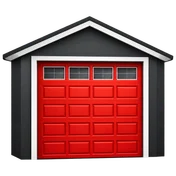


Standard garage door sizes for single and double doors
Garage door sizes are always written width by height, so a 16x7 is 16 feet wide and 7 feet tall. Manufacturers' sizing guides list 8x7 and 9x7 as the most common single doors and 16x7 as the baseline double, with 7 feet the standard height and 8 feet widely available. Standard residential widths include 8, 9, 10, 12, 14, 15, 16 and 18 feet, heights come in 3-inch steps up to 8 feet, and many models can be ordered in custom sizes.
The size usually tracks the age of the house. Older homes and detached garages often have narrower openings, sometimes 8 feet wide or less, which can feel tight with today's mirrors. Subdivisions built in recent decades mostly have 16-foot doubles, sometimes next to a single for a third bay.
| Door type | Common sizes (width x height) | Typical use |
|---|---|---|
| Single | 8x7, 9x7, 10x7 | One car; a 9-foot width leaves more room for mirrors |
| Single, tall | 8x8, 9x8, 10x8 | SUVs, pickups and roof racks |
| Double | 16x7, 18x7 | Two cars side by side |
| Double, tall | 16x8, 18x8 | Two larger vehicles |
| Oversized and RV | Heights of 10 to 14 feet, widths up to about 20 feet | Campers, boats and lifts, usually by special order |
Is a 7-foot or 8-foot tall garage door better?
A 7-foot door clears most cars, minivans and SUVs. If you drive a full-size pickup or a lifted truck, or you keep a roof box or bike rack on top, an 8-foot door is worth considering. It's a common upgrade when a door is replaced and the framing is changed at the same time.
Raising an opening means reframing the header and often moving the opener, so it's a bigger job than a door swap. Taller doors also need more headroom above the opening and a longer opener rail or an extension kit, because the door travels farther. Check the room before you fall for the extra foot.
How do I measure for a new garage door?
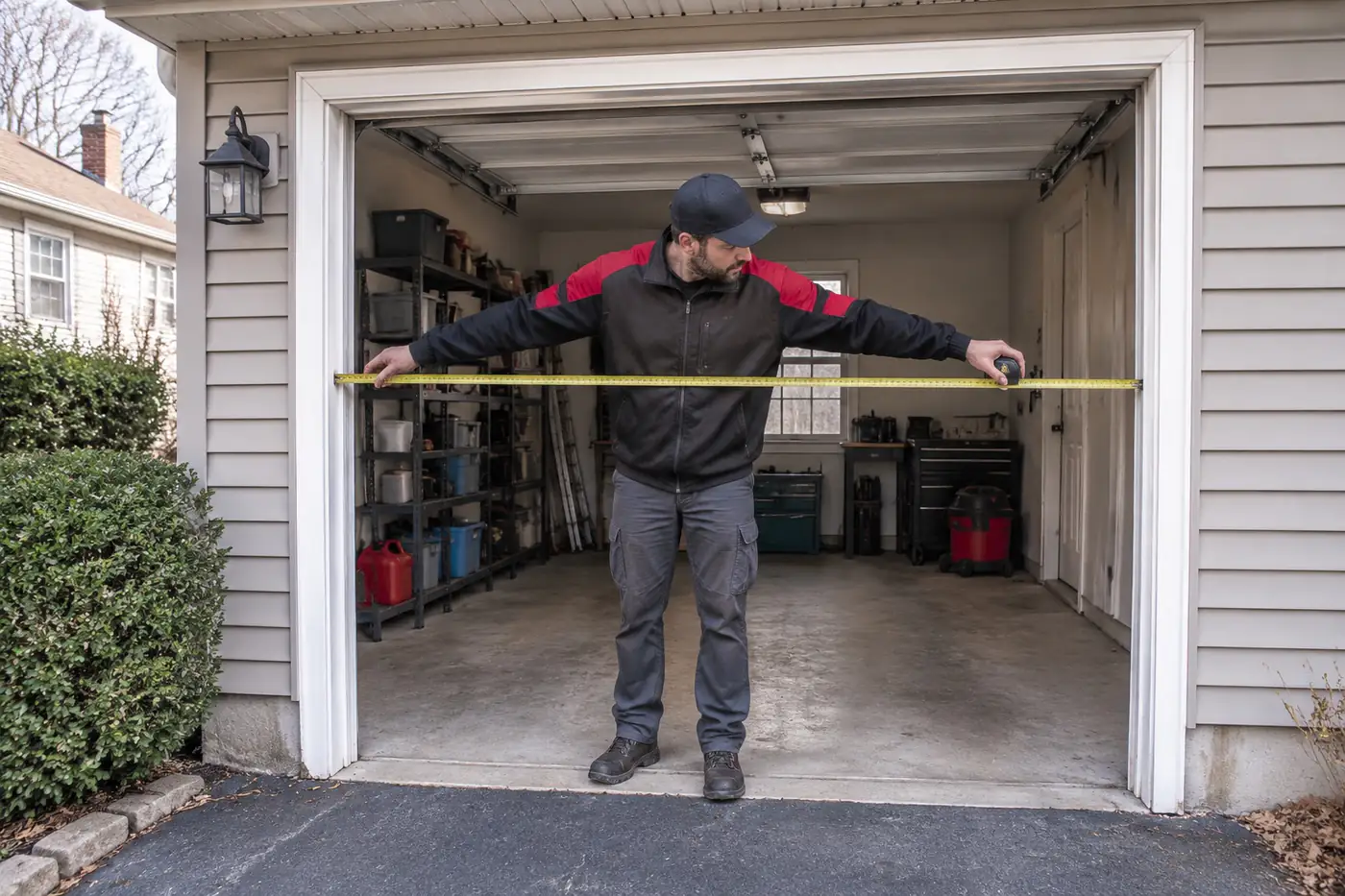
You need five measurements, all taken inside the garage with a tape measure and a helper if possible:
Write the numbers down with a sketch of anything hanging from the ceiling. Those clearances decide which track and spring system the door can use, and they're the first thing we check at an estimate. If a number looks tight, low-headroom track kits and wall-mount openers solve a lot of crowded garages.
- Width: measure the finished opening between the side jambs at the top, middle and bottom, and use the smallest number.
- Height: measure from the floor to the underside of the header on both sides and in the middle, and use the shortest, since garage floors often slope toward the door.
- Headroom: measure from the top of the opening to the ceiling or the lowest obstruction, such as a beam, pipe or the opener. Manufacturers' minimums are about 10 inches for extension springs and 12 inches for torsion springs, with low-headroom hardware for less.
- Side room: measure from each side of the opening to the nearest wall or obstruction, and plan on at least 3-3/4 inches per side for standard track and springs, with more for some spring systems or a wall-mount opener.
- Backroom: measure from the opening straight back to the rear wall or the first obstruction, and allow at least the door height plus 18 inches, with more for an automatic opener.
Is it cheaper to have one garage door or two?
Usually one is cheaper. A single 16-foot door needs one set of tracks, one spring system and one opener, while two singles need two of each, plus a post between them. That's why double garage door cost usually comes in below the price of two single doors. This Old House's 2026 garage door cost guide says double doors are generally more cost-effective, and it puts doors for a one-car garage at about $1,093 to $1,674 and for a two-car garage at about $2,186 to $3,348. Those are national figures. The actual price depends on the door, its insulation and the work involved, and Alpha Pro gives you a written price onsite before anything starts.
Two doors still have advantages. If one door or opener fails, the other bay keeps working. Each door is lighter, so its springs are smaller, and two narrower openings make it harder to clip a mirror when backing in. Changing from one door to two, or the reverse, means reframing the opening, so it usually happens during a larger renovation. For more on pricing, see our garage door installation cost guide.
Choosing a style once you know the size
Every major brand makes doors in the standard sizes, so size rarely limits your style. A 16x7 opening can take a raised-panel steel door, a carriage-house design with decorative hardware, or a flush modern door with a row of glass across the top. Size does affect weight, and a heavier door, like an insulated double with windows, needs springs and an opener matched to it.
See garage door styles for the looks we install, and our garage door brands comparison for how the big manufacturers' product lines differ.
Getting the size right at your estimate
We measure every opening before ordering, because an inch off means extra trim work or a door that doesn't seal at the sides. Our garage door installation team checks the jambs, header, floor slope, headroom, side room and backroom, then gives you a written price for the door and the work. Estimates are free with no obligation, and you can book a visit online in a two-hour arrival window, up to two weeks ahead.
Odd-sized openings are common in older garages, especially ones that were framed by hand or altered over the years. You have two choices: order a door built to the opening, which some manufacturers offer in 2-inch width steps, or reframe the opening to the nearest standard size. We'll measure the opening and talk through both options at a free estimate, so you can weigh a custom door against the carpentry.
Questions people ask
What sizes do garage doors come in?
Common single doors are 8x7 and 9x7, common doubles are 16x7, and 8-foot heights are widely available for taller vehicles. Residential widths generally run from 8 to 18 feet, with larger and custom sizes by special order.
Is it cheaper to have one garage door or two?
One double door is usually cheaper than two singles, because it needs one set of tracks, springs and opener. This Old House's 2026 cost guide also calls double doors generally more cost-effective. Two doors cost more but keep one bay working if the other fails.
How do I measure for a new garage door?
Measure the opening's width and height at several points and use the smallest numbers. Then measure headroom above the opening, side room on each side, and backroom to the rear wall. Those clearances decide which track and spring system will fit.
What size is a standard two-car garage door?
Most two-car garages have a 16x7 door, and 16x8 is the common taller option. Some homes use an 18-foot-wide double for more room between cars.
What is the standard height of a garage door?
Seven feet is the standard residential height. Eight-foot doors are common for SUVs and pickups, and anything taller is usually a special order for RVs or lifts.
Rather have it handled?
Our technicians handle new garage doors across Jackson, Ocean County and Monmouth County, with a written price before any work starts.
Sources
- clopaydoor.com/residential/buyingguide/what-is-the-average-garage-door-size
- clopaydoor.com/residential/buyingguide/residential-faq
- blog.amarr.com/whats-the-standard-garage-door-height-a-garage-door-sizing-guide
- thisoldhouse.com/home-finances/garage-door-cost
- clopaydoor.com/residential/buyingguide/garage-door-openers