The short answer
Belt drives make the least noise of the rail types and suit garages with rooms above. Chain drives cost less and handle heavy doors well.
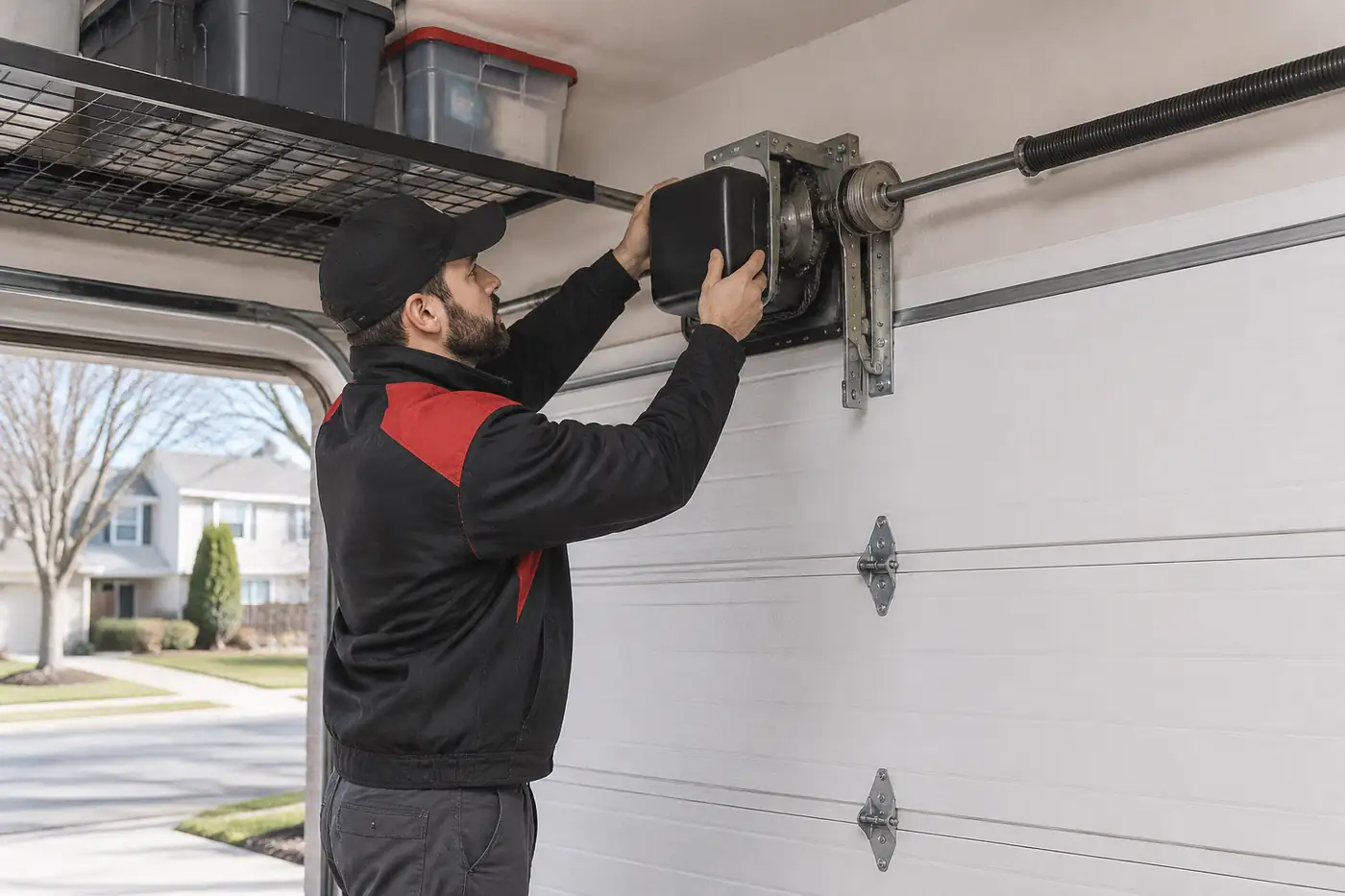
Wall-mount, or jackshaft, openers clear the ceiling but need a torsion-spring door and some room beside it.
Most new openers include Wi-Fi app control, and add-on smart controllers work with many openers made after 1993.
Plan on roughly 10 to 15 years from an opener, the range in the home builders' life expectancy study.

What's the best garage door opener type for your garage?
There isn't one best garage door opener for every house. The right one depends on where the garage sits, how heavy the door is, how much ceiling you have, and how you want to control it. Here's how we'd sort it for a typical New Jersey home:
Horsepower is the other half of the match. Door makers' buying guides say a 1/2 HP opener usually handles a standard single or double door, while heavier insulated, wood or oversized doors call for 3/4 HP or more. Doors 8 feet tall need a longer rail or an extension kit.
- Attached garage with a bedroom or family room above or beside it: a belt drive with a DC motor.
- Detached garage or a tight budget: a chain drive, ideally one with a DC motor for smoother starts and stops.
- Low ceiling, overhead storage racks or a tall cathedral ceiling: a wall-mount opener, if the door has torsion springs.
- Heavy wood or oversized door: a unit rated for the door's weight and size, matched by a technician after a balance check.
- Garage with no side entrance: any drive type, plus battery backup and an exterior emergency release.
Garage door opener types compared
Chain and belt units are what you'll find in most New Jersey garages. Screw drives use fewer moving parts, but their own makers say they're sensitive to dramatic seasonal temperature swings, and an unheated garage here goes from freezing in January to sweltering in July. That's why we rarely suggest one.
| Type | How it works | Noise | Best for | Watch out for |
|---|---|---|---|---|
| Chain drive | Metal chain pulls a trolley along a rail | Loudest | Detached garages, heavy doors, lower budgets | Chain needs occasional adjustment |
| Belt drive | Steel-reinforced belt pulls the trolley | Lowest of the rail types | Attached garages with living space nearby | Costs more than a comparable chain unit |
| Screw drive | Motor turns a threaded steel rod | Moderate | Simple design with fewer moving parts | Sensitive to big seasonal temperature swings |
| Wall-mount (jackshaft) | Mounts beside the door and turns the torsion bar | Low | Low or crowded ceilings, tall doors | Needs torsion springs and a nearby outlet; usually costs the most |
Chain drive vs belt drive: is a belt drive opener better?
For an attached garage, usually yes. A belt drive does the same job with a reinforced belt instead of a steel chain, so it runs with much less noise and vibration, which matters when someone sleeps over the garage. Chain drives are cheaper, durable, and perfectly good for a detached garage where the noise never reaches the house.
The motor matters as much as the drive. DC motors start and stop softly, make less noise, and are the type that supports battery backup. A modern DC chain drive is far smoother than the old AC chain units many homes still have, so don't rule out chain if the budget is tight. Our garage door opener installation cost guide covers what each type typically runs.
Wall-mount garage door openers: when they make sense
A wall-mount opener sits on the wall beside the door and turns the torsion bar directly. There's no rail down the middle of the ceiling, which frees overhead space for storage racks, a car lift, or a high-lift track on a tall ceiling. Genie, for example, says its wall-mount frees at least 48 inches of ceiling space, and LiftMaster rates its 98022 wall-mount for doors up to 14 feet tall and 18 feet wide with about 3 inches of clearance above the torsion bar.
They don't fit every door. A wall-mount needs a sectional door with torsion springs on a bar above the opening, so it won't work with extension springs or one-piece doors. You also need clear wall beside the end of the torsion bar and an outlet within reach of a short cord. A technician should check the bar, drums and side room before you buy one.
Smart garage door openers and features worth paying for
Most new LiftMaster, Chamberlain and Genie openers come with Wi-Fi app control built in. You can open and close from your phone, get an alert when the door is left open, and let in a dog walker or a delivery without handing out a remote. If your opener works fine, you may not need a new one to get this. Chamberlain says its add-on smart controller works with openers made after 1993 that have safety sensors and a learn button, on sectional doors, with some brand and radio exceptions.
If your remotes or keypad stopped working, they can often be reprogrammed or replaced without a new opener; see remote and keypad repair. Beyond app control, these are the features we'd put on the list:
- Battery backup: keeps the door running through short outages after summer storms and nor'easters.
- Rolling-code remotes and keypads: the code changes with each press, which makes it hard to copy.
- Integrated LED lighting: brighter light and no bulbs shaking loose from vibration.
- Soft start and stop: easier on the door, its hardware and anyone sleeping nearby.
How long do garage door openers last?
The National Association of Home Builders' life expectancy study lists garage door openers at 10 to 15 years. Genie puts a typical opener at 7 years or more, with some running far longer on good maintenance, and notes that service parts may be unavailable for units older than about 10 years. A door that's out of balance makes any opener work harder and wear out sooner.
It's time to replace rather than repair when parts aren't available, the motor strains or hums, the unit is loud and you want app control, or the opener has no safety sensors at all. Federal rules require openers made since 1993 to reverse when they hit an obstruction, and a unit older than that should go. If yours is acting up but otherwise healthy, start with our guide to a garage door opener not working or book garage door opener repair.
Getting a new opener installed right
An opener is only as good as the door it lifts. Before we install one, we check the springs, cables and balance, because a new motor on a heavy, unbalanced door wears out fast. Then we mount the rail or wall unit, set the travel limits and force, align the photo-eyes, program your remotes and keypad, connect the app if you want it, and finish with a balance check and an auto-reverse test. We install and repair all major brands, including LiftMaster, Chamberlain and Genie. See garage door opener installation for what's included, or request a free estimate.
Questions people ask
What type of garage door opener is best?
For most attached garages, a belt drive with a DC motor is the best mix of low noise, smooth operation and features. Chain drives make sense for detached garages and tighter budgets, and wall-mount units are best when you want the ceiling clear and the door has torsion springs.
Is a belt drive opener better than chain drive?
It's better for noise, not necessarily for strength. Belt drives run with much less noise and vibration, while chain drives cost less and lift a typical door just as well. Pick a belt if living space shares a wall or ceiling with the garage.
How long do garage door openers last?
Usually about 10 to 15 years, the range the National Association of Home Builders lists for openers. Heavy use or a poorly balanced door shortens that, and regular maintenance stretches it.
Can a wall-mount opener work on any garage door?
No, it can't. Wall-mount openers need a sectional door with a torsion spring bar, plus clear space beside the bar and an outlet nearby. Doors with extension springs and one-piece doors need a rail-type opener.
Do I need a new opener to get smartphone control?
Often you don't. Add-on smart controllers work with many openers made after 1993 that have safety sensors and a learn button, though some older or off-brand units aren't compatible. New openers from the major brands usually have Wi-Fi built in.
Rather have it handled?
Our technicians handle opener installation across Jackson, Ocean County and Monmouth County, with a written price before any work starts.
Sources
- store.geniecompany.com/blogs/genie-blog/garage-door-openers-a-buyer-s-guide-to-the-types-of-genie-garage-door-openers
- clopaydoor.com/residential/buyingguide/garage-door-openers
- shankdoor.com/wp-content/uploads/2023/12/98022_Product_Guide_EN.pdf
- support.chamberlaingroup.com/s/article/garage-door-openers-compatible-with-smart-garage-control
- standards.nsf.org/higherlogic/ws/public/download/348/NAHB%202007%20StudyUseful%20Life%20of%20Home%20Components.pdf
- store.geniecompany.com/blogs/genie-blog/preventative-maintenance-replace-your-garage-door-opener-before-breakdown
- law.cornell.edu/cfr/text/16/1211.7
- ecfr.gov/current/title-16/chapter-II/subchapter-B/part-1211/subpart-A
- support.chamberlaingroup.com/s/article/How-to-Manually-Open-or-Close-a-Garage-Door