
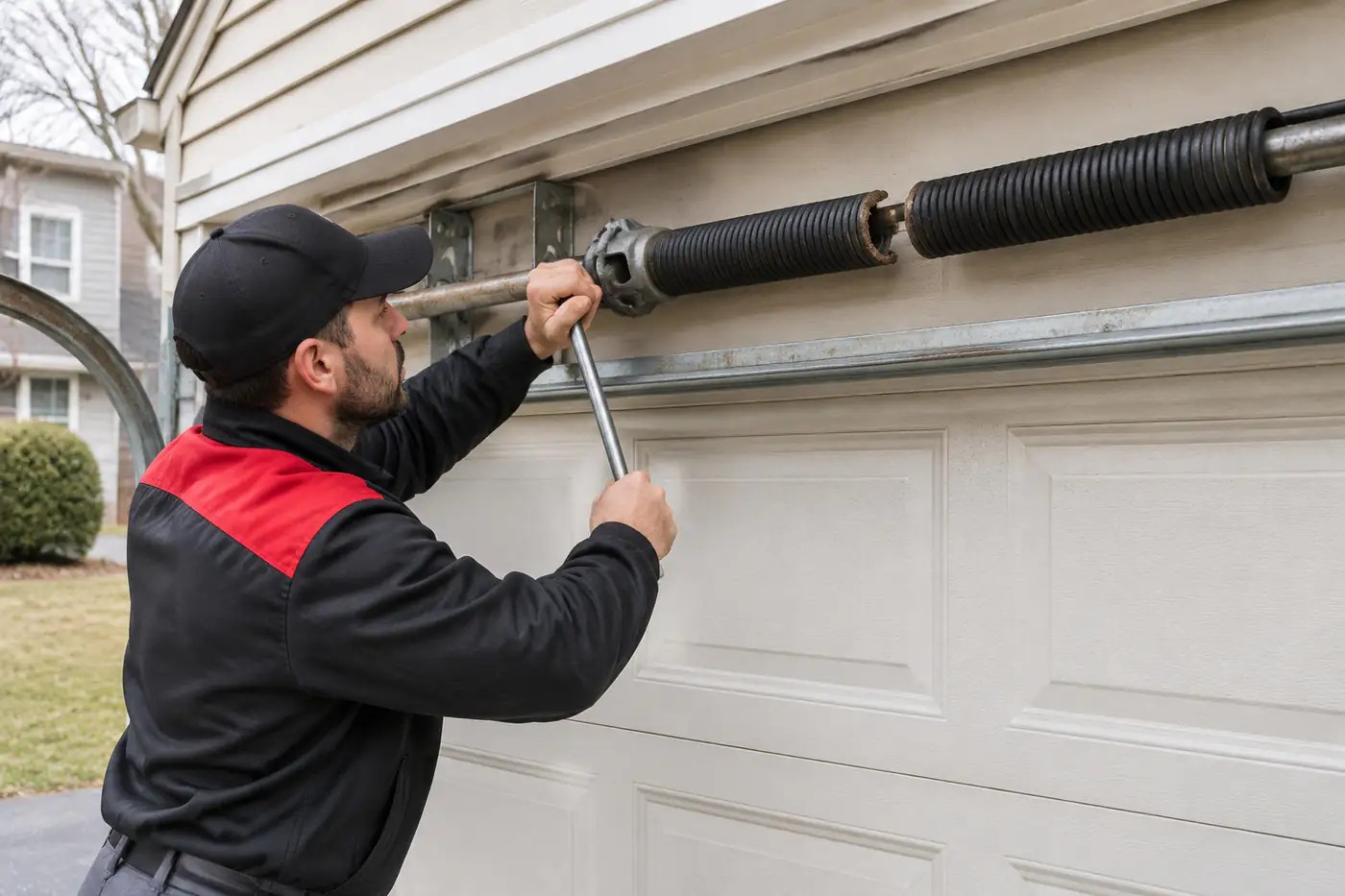
Most homeowners find out they need garage door spring repair the same way: a loud bang from the garage, then an opener that hums, lifts the door a few inches and stops. The springs carry the weight of the door, not the opener, so once one breaks the door is suddenly far heavier than the motor was built to lift. Replacing a spring isn't a matter of grabbing a match off a shelf, either. The new springs have to suit your door's weight, height and cable drums, or the door will never balance properly.
We replace torsion and extension springs in homes across Ocean and Monmouth County, seven days a week. Below is how each type works, why springs fail, what you should and shouldn't do while you wait, and what the job involves from start to finish.
What to look for
A loud bang from the garage
A torsion spring breaking sounds like a gunshot or a dropped board. People often hear it with the door closed and nobody near it.
A gap in the coil
Look at the spring on the bar above the door. A break shows as a clear gap of an inch or two where the coil has separated.
Opener lifts a few inches and quits
Newer openers sense the extra weight and stop or reverse. Older ones keep straining, which can strip the drive gear.
Loose or tangled cables
When a spring lets go, tension drops and the lift cables can go slack or unwind from the drums at the top corners.
Springs past their cycle life
A door still on its original springs after seven or more years that starts to slow, jerk or strain is close to a break.


Torsion or extension: which springs does your door have?
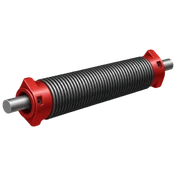
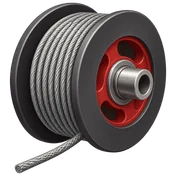
Look above the top of the door. If you see one or two large springs wrapped around a steel bar, with a cable drum at each end of the bar, you have torsion springs. When the door closes, the cables unwind from the drums and the springs twist tighter, storing the energy that lifts the door on the way back up. Heavier two-car doors usually have two torsion springs; lighter doors may have one.
If instead you see long springs running above the horizontal tracks on each side, parallel to the ceiling, you have extension springs. They stretch as the door closes and pull it up through a set of pulleys and cables as it opens. They're common on older homes and single-car garages. Each one should have a safety cable running through its center so a broken spring can't whip across the garage, and if yours don't, we can add them. Some homeowners convert to torsion when the extension springs are due anyway, since the door runs smoother and a broken torsion spring stays on its bar. Our torsion versus extension springs guide compares the two in detail.
Why garage door springs break
Springs wear out from use. Every open-and-close is one cycle, and a standard spring is commonly rated for around 10,000 cycles. At four cycles a day, about 1,460 a year, that works out to roughly seven years. Households that come and go through the garage all day get there faster, and for them a high-cycle spring, built to last many more cycles, is usually worth it.
New Jersey weather speeds things up. Cold steel is less forgiving, and on a January morning the grease in the rollers and bearings has thickened, so the springs work harder on every lift. A spring near the end of its life often lets go on one of those first hard freezes. Near the shore, humidity and salt air rust the coils, and rust adds friction between them every time the spring winds and unwinds. Around Barnegat Bay and the tidal rivers, galvanized or coated springs hold up better than plain oil-tempered ones.
Sizing matters too. A spring that's too small for the door, or a single spring doing the work of two, runs at higher stress on every cycle and wears out early. That's one reason we size new springs to the door instead of copying whatever was on it. A yearly tune-up catches weak and rusted springs before they break.
What's safe to do with a broken spring
The short version: stop using the door and leave the springs alone. A wound torsion spring holds enough energy to break bones, and the cables and bottom brackets are under the same tension.
- Unplug the opener, or at least stop pressing the button. Each try strains the motor and can pull a cable off its drum.
- If the door is closed, leave it closed. It's safest down, and the garage stays secure.
- If the door is open, keep people, pets and cars out from under it, and don't pull the red release cord. With a broken spring, the opener is the only thing holding the door up.
- Never try to wind, unwind or clamp a torsion spring with screwdrivers or pipe. Winding takes proper winding bars and training.
- If your car is stuck inside, call (732) 555-0142 before trying to lift the door by hand. Our emergency repair page covers what to do in the meantime.
What garage door spring repair involves
If your door has two springs and one broke, the other has done exactly the same number of cycles and is usually close behind. Replacing only the broken one leaves a new spring and a worn spring pulling against each other, which makes the door harder to balance and means a second visit later. So we replace springs in pairs, and the same goes for extension springs on both sides.
We check the cables, drums and center bearing at the same time. A spring that lets go can kink a cable or knock it off its drum, and frayed cables are worth replacing while the tension is already off. If they're worn, they'll appear on your written price as a separate item and the choice is yours. More on that on our cable repair page, and our broken garage door spring guide explains how to confirm a break and what to tell us when you call.
How the visit works
Confirm the spring system
We identify torsion or extension springs, find the break, and check cables, drums, bearings and pulleys for damage the break may have caused.
Size the new springs
We measure wire size, inside diameter, length and wind direction, then check them against the door's weight and height rather than trusting what was there.
Install and wind
With the door secured, the old springs are unloaded with winding bars, the new pair goes on, and each spring is wound to the right number of turns.
Balance and test
The door should hold at halfway on its own. We lubricate the springs, reset the opener's force and limits, and finish with an auto-reverse test.
Questions people ask
Can I use my garage door if one spring is broken?
No, you shouldn't run it. With one spring broken, the door is too heavy for the opener and too heavy to lift safely by hand, and running it can strip the opener's gear or knock a cable off its drum. Leave it closed if it's closed, unplug the opener, and call us.
How long do garage door springs last?
A standard spring is commonly rated for about 10,000 cycles, and one cycle is one open plus one close. At four cycles a day that's roughly seven years, and busier households get less. High-cycle springs last considerably longer and make sense if the garage is your main entrance.
How do I know what garage door torsion spring I need?
Torsion springs are specified by wire size, inside diameter, length and wind direction, and the right combination depends on the door's weight, height and cable drums. Measuring the old spring is a starting point, but it may have been the wrong size to begin with. We size springs to the door and confirm the choice by checking balance after installation.
Should I spray WD-40 on my garage door spring?
Standard WD-40 is mainly a cleaner and water displacer, so it doesn't leave much lasting lubrication. A light coat of garage door lubricant, usually a silicone or white lithium spray, on the coils a couple of times a year cuts friction, noise and rust. Lubricant helps a healthy spring, but it won't save a worn or broken one.
Why do so many springs break in winter?
Cold doesn't break a healthy spring, but it finishes off tired ones. Stiff grease and cold steel make every lift harder, so a spring near the end of its cycle life often fails on a frigid morning. Rust from shore humidity makes the problem worse.
How much does garage door spring replacement cost?
It depends on the spring type, the size your door needs, and whether you have one spring or two. We give you a written price after looking at the door, and the estimate is free. For typical ranges from national cost surveys, see our spring replacement cost guide.
Can extension springs be converted to torsion springs?
Yes, on most residential doors with enough room above the opening. A conversion means new hardware: a torsion bar, springs, drums, bearings and cables. It's worth considering when your extension springs are due anyway.