
The short answer
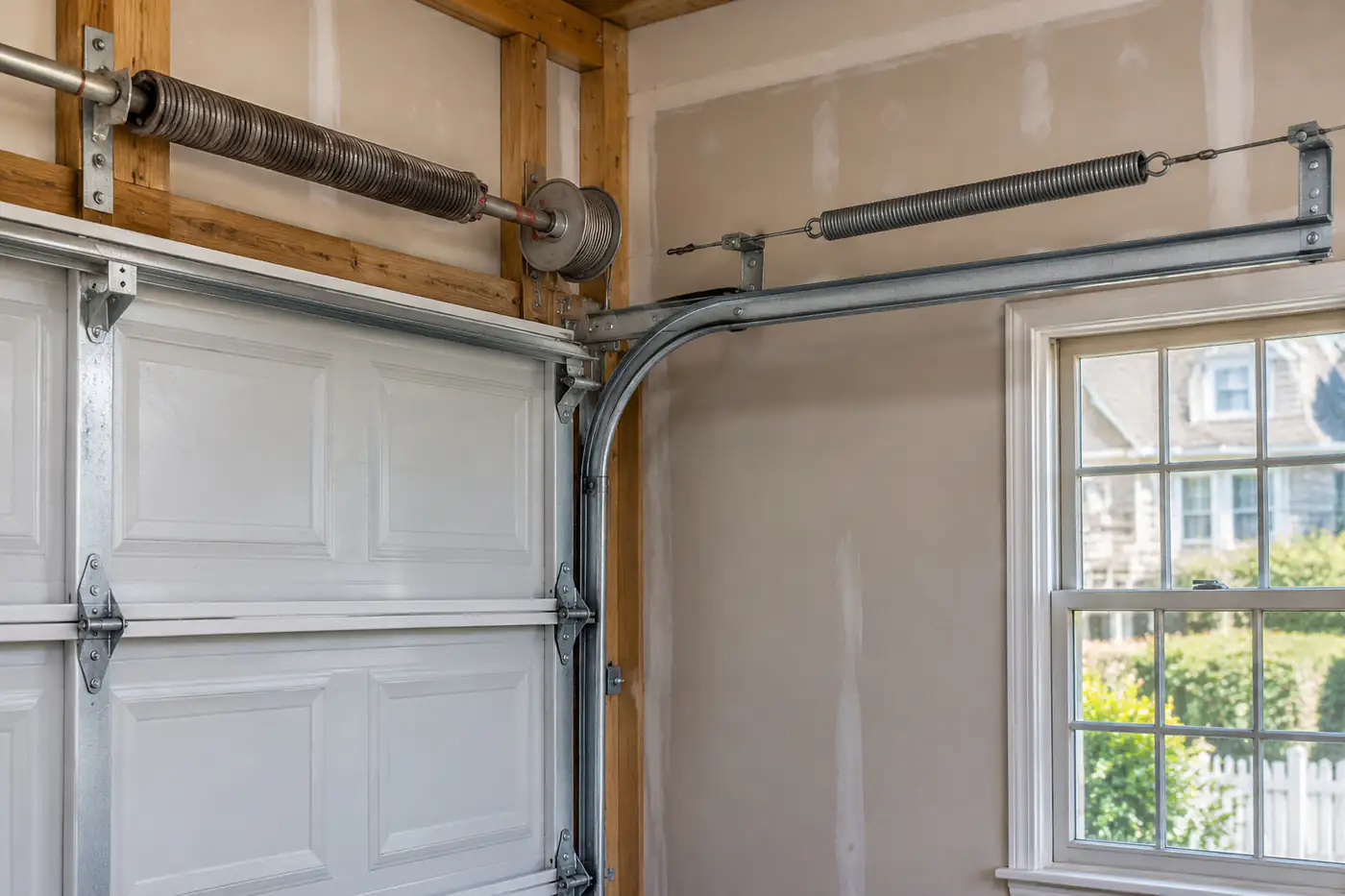
Look up with the door closed: a spring on a bar above the opening is torsion, and springs running beside the overhead tracks are extension.
Standard springs are commonly rated around 10,000 cycles. At about 1,500 cycles a year, that's roughly six to seven years.
Every extension spring needs a containment cable running through it so a broken spring can't fly loose.
Converting from extension to torsion springs is possible, and national surveys price it at $400 to $800.



What is the difference between torsion and extension springs?
Both garage door spring types do the same job: they carry the weight of the door so that you, or your opener, only have to guide it. A balanced door feels light and stays put when you let go halfway up. The difference is how each type stores that energy.
Torsion springs sit on a steel shaft mounted above the door opening. Clopay, one of the largest door makers, describes them as using torque to lift the door, winding and unwinding as it moves. A cable drum sits at each end of the shaft, and lift cables run from those drums down to the bottom corners of the door. As the door rises, the spring unwinds and turns the shaft, and the drums wind up the cable.
Extension springs run parallel to the horizontal tracks on each side of the door. They stretch as the door closes and pull it up as they contract, working through a set of pulleys and cables. Clopay notes they're under maximum tension when the door is closed, which is also when most springs break.
Torsion vs extension springs at a glance
The life and cost figures below come from HomeAdvisor's 2026 spring cost guide. Your own springs may be rated differently, so treat these as typical ranges.
| Feature | Torsion springs | Extension springs |
|---|---|---|
| Where they sit | On a shaft above the door opening | Beside each horizontal track |
| How they work | Twist and unwind as the door moves | Stretch as the door closes, contract as it opens |
| Typical cycle life | 10,000-20,000 cycles | 8,000-15,000 cycles |
| Typical years of service | About 8-15 years | About 7-12 years |
| When one breaks | Stays on the shaft, which contains it | Can whip loose unless a cable runs through it |
| Lifting feel | Smooth, even lift across the door | Each side works on its own and can pull unevenly as springs wear |
| Replacement cost per spring | $75-$150 with labor | $50-$100 with labor |
| Headroom | Needs some clear space above the opening | Suits garages with very little headroom |
Which garage door spring type do you have?
You can tell without touching anything. Close the door, stand inside the garage, and look up at the wall above the opening and at the tracks along the ceiling. DASMA's home inspection checklist has you check springs this way, from inside with the door fully closed.
- One or two coils on a bar above the door: standard torsion springs. Single-car doors often have one, and double doors usually have two.
- A steel tube above the door with no visible coils: an enclosed torsion system, with the springs hidden inside the tube.
- Long springs running from the back of the tracks toward the front, with pulleys: extension springs. Check that a cable runs through the middle of each one.
- A visible gap in a coil, or one extension spring hanging slack: a broken spring. Stop using the door and read our broken garage door spring guide.
How long do garage door springs last?
Springs are rated in cycles, and one cycle is one full open and one full close. DDM Garage Doors, a spring supplier, notes that standard residential torsion springs are commonly built around a 10,000-cycle rating, and Clopay says most springs are rated for 10,000 cycles. Clopay also estimates the average garage door opens and closes about 1,500 times a year. Divide one by the other and a standard spring lasts roughly six to seven years in a typical home.
Your number may be very different. If the garage is the way your family comes and goes, four trips out and back a day is about 1,460 cycles a year, and a busy household can double that. DDM's own math shows a 10,000-cycle pair lasting about 2.7 years at ten cycles a day. That's why high-cycle springs, sold in ratings such as 27,000 and 54,000 cycles, are worth asking about when it's time to replace them.
Weather plays a part too. Springs most often break in cold weather, Clopay notes, and homes near the bay or ocean in Ocean and Monmouth counties see more rust on springs, which shortens their life. A light coat of garage door lubricant on the coils a few times a year helps, and our lubrication and maintenance checklist has more on keeping hardware in shape.
Can you convert extension springs to torsion springs?
Yes, it can be done. A conversion removes the extension springs, pulleys and cables and replaces them with a torsion shaft, springs, cable drums and a center bracket mounted to the wall above the door. The door needs enough headroom for the shaft and a solid header to anchor the bracket. Angi and HomeAdvisor put the conversion at $400 to $800 nationally, and our spring replacement cost guide compares it with a like-for-like swap.
It's worth considering when your extension springs have no containment cables, when the door is heavy, or when you want a wall-mount opener as part of an opener installation. Wall-mount (jackshaft) openers need a torsion spring shaft. LiftMaster's requirements for its residential jackshaft openers call for a 1-inch torsion bar on a properly balanced door.
Why spring work belongs to a technician
DASMA, the door industry's trade association, warns homeowners not to remove, repair or adjust springs, cables, brackets or anything they're mounted to. A torsion spring holds its energy whenever the door is closed, and winding or unwinding it takes proper winding bars and training. Extension springs are under their highest tension with the door down, and the bottom brackets that hold the lift cables are under load too.
When we replace springs, we match them to your door's weight and height, replace both on a two-spring door, and finish with a balance check and an auto-reverse safety test. See our garage door spring repair page for what's involved, or book a visit and get a written price before any work starts.
Questions people ask
What is the difference between torsion and extension springs?
Torsion springs twist on a shaft mounted above the door and lift it by unwinding. Extension springs run along the tracks on each side and lift the door by contracting after being stretched. Torsion springs usually last longer and stay contained on the shaft when they break, while extension springs cost less and suit garages with very little headroom.
How long do garage door springs last?
Standard springs are commonly rated for about 10,000 cycles, and one cycle is one open and one close. At the roughly 1,500 cycles a year Clopay estimates for a typical door, that's about six to seven years. Heavy daily use shortens that, while high-cycle springs stretch it out.
Can you convert extension springs to torsion springs?
Yes, as long as there's enough headroom above the door and a solid header to mount the torsion hardware. The conversion replaces the springs, pulleys and cables with a torsion shaft, springs and cable drums. Angi and HomeAdvisor put it at $400 to $800 nationally.
Are torsion springs better than extension springs?
For most doors, yes. Torsion springs tend to last longer, lift more evenly and stay on their shaft when they break. Extension springs are still a sound choice for lighter doors and low-headroom garages, as long as each spring has a containment cable.
Rather have it handled?
Our technicians handle spring repair across Jackson, Ocean County and Monmouth County, with a written price before any work starts.
Sources
- clopaydoor.com/residential/buyingguide/garage-door-spring-system
- clopaydoor.com/blog/post/blog/2021/03/05/do-i-have-a-broken-garage-door-spring
- garaga.com/garage-door-parts/hardware/springs
- ddmgaragedoors.com/pages/high-cycle-garage-door-torsion-springs
- homeadvisor.com/cost/garages/garage-door-spring-repair/
- angi.com/articles/how-much-should-garage-door-spring-replacement-cost.htm
- dasma.com/wp-content/uploads/2023/04/TDS167.pdf
- support.chamberlaingroup.com/s/article/Jackshaft-Opener-Installation-requirements-for-the-Residential-Jackshaft-Openers