The short answer
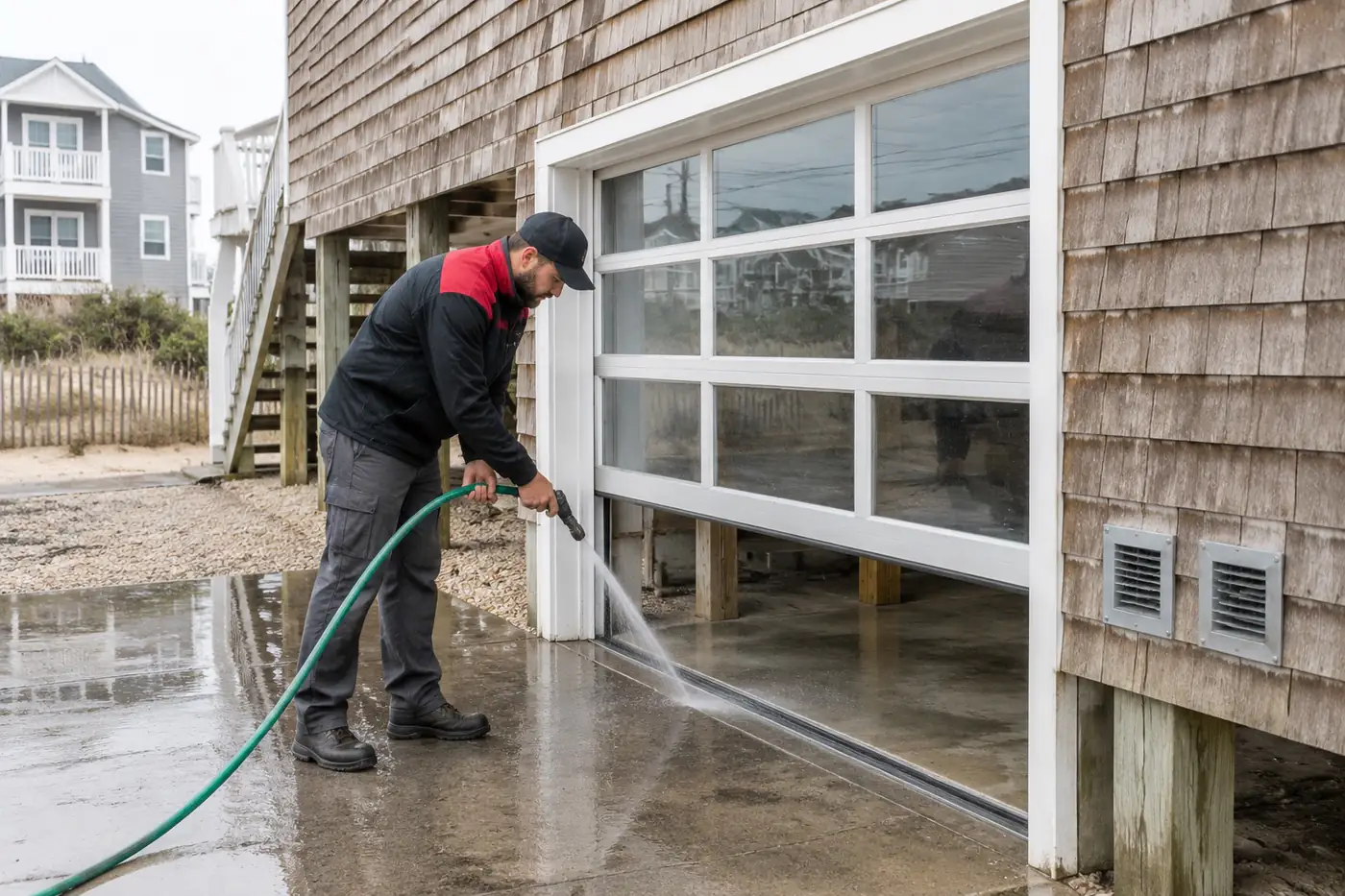
Salt spray is heaviest within a few thousand feet of the water, but bay and river homes see it too. Rinse the door and hardware with fresh water regularly.
Aluminum, composite and well-coated galvanized steel hold up best. Upgrade to stainless hardware where the exposure is worst.
New Jersey's residential code calls for garage doors tested and labeled for wind pressure. Your local construction office sets what your site needs.
On raised homes in flood zones, the garage door can't serve as a flood vent. Openings go in the walls, or engineered vents go in the door.




Why salt air causes garage door rust so fast
Salt is the problem, more than water. Wind off the ocean and the bays carries fine salt particles that settle on the door skin, springs, hinges, rollers and track, then pull moisture out of the air. That damp, salty film keeps working on bare steel and uses up the zinc coating on galvanized parts much faster than inland air does. One structural hardware maker's corrosion guidance notes that salt spray drops off sharply between about 300 and 3,000 feet from the shoreline, so oceanfront blocks take the worst of it. Homes along Barnegat Bay, the Metedeconk and the Manasquan River still see plenty.
The first parts to go are usually the ones you don't look at: the torsion spring, the bottom brackets where the lift cables attach, the cables themselves, and the bottom of the tracks where sand and puddles collect. Rust there isn't cosmetic. A pitted spring is more likely to snap, and a rusted bottom bracket or cable can let go under tension. Inland, road salt dripping off cars does a smaller version of the same thing to the bottom section.
What garage door material is best near the beach?
For homes close to the water, aluminum or a composite-clad door gives the longest life with the least work. Steel is still the most common and most affordable choice, and a well-made insulated steel door with a galvanized core and factory paint does fine a few blocks back from the beach, as long as you rinse it, wax it and touch up scratches. Wood looks right on a shingled shore colonial but needs the most care.
Whatever the door is made of, the hardware decides how long it keeps working.
| Material | How it handles salt air | Upkeep |
|---|---|---|
| Aluminum | Doesn't rust; a common pick for coastal homes, especially with glass | Rinse regularly; dents more easily than steel |
| Composite cladding over steel | Cladding resists moisture, warping and cracking | Low; keep an eye on steel edges and hardware |
| Fiberglass | Doesn't rot and resists corrosion | Low; check the finish for sun wear |
| Galvanized steel with factory paint | Good while the coating is intact; scratches and cut edges rust first | Rinse, wax twice a year, touch up scratches |
| Wood | Won't rust, but salt air and humidity are hard on finishes | High; regular sealing or painting |
Galvanized vs stainless garage door hardware
Standard residential hardware is galvanized steel. Hinges, brackets, track and roller stems carry a zinc coating that corrodes first to protect the steel underneath. Near the water that sacrificial coating gets used up faster, and once it's gone, the steel rusts quickly. Stainless steel resists salt far better, and for the harshest spots structural hardware makers point to Type 316 stainless, which holds up better than Type 304 in salty, chloride-heavy air.
Stainless parts cost more, and not every component comes in stainless, so a practical upgrade on a shore home usually looks like this:
- Stainless or heavily coated hinges, fasteners and bottom brackets
- Nylon rollers with sealed bearings and corrosion-resistant stems
- Galvanized or coated torsion springs instead of plain oil-tempered springs
- Corrosion-resistant lift cables, inspected at every service visit
How do you keep a garage door from rusting near the ocean?
A little routine care goes a long way. This is the schedule we suggest for homes near the ocean, the bays and the tidal rivers:
A yearly garage door maintenance visit catches corrosion on the parts under tension before it turns into a broken spring or cable. If the bottom seal is cracked or the side seals let in wind-driven rain, weather seal replacement is a small job that protects the bottom section.
- Rinse with fresh water every few weeks in summer and after every big storm or nor'easter, using a garden hose rather than a pressure washer on the door face, tracks, hinges and springs.
- Wash and wax steel doors twice a year with mild soap and a spray-on car wax, as door makers recommend for coastal homes.
- Lubricate more often, about every three months, using silicone spray or garage door lubricant on hinges, roller bearings and springs; our garage door lubricant and maintenance checklist shows where.
- Touch up scratches on the door skin and track promptly so bare steel isn't left exposed.
- Keep the bottom dry by replacing a flattened bottom seal and sweeping sand away from the threshold.
- Inspect after storms for rust on springs, cables and bottom brackets, and for loose or corroded fasteners.
Do I need a wind-rated garage door in New Jersey?
Plan on it. New Jersey's residential code is based on the International Residential Code, which requires garage doors to be tested for wind pressure, to ANSI/DASMA 108 or ASTM E330, and to carry a permanent label naming the manufacturer, the model, the positive and negative design pressure rating, the installation drawing and the test standard. DASMA, the door industry's trade group, points out that the rating is a design pressure in pounds per square foot, not a wind speed, and that the local code official has the final say on what's required.
The pressure a door needs depends on the address. The state Department of Community Affairs directs designers to site-specific wind values from the ASCE hazard tool, and the required rating also depends on exposure, door size and building height. An oceanfront house on open sand takes more wind than one tucked behind trees a few miles inland. New Jersey's code amendments list the windborne debris region entry as not applicable, so ask your construction office whether impact-rated glass is required before you pay extra for it.
Wind rating is more than a code box. Garage doors are usually large, unreinforced openings, and once one fails in a storm, wind can pressurize the house and push out windows, walls and even the roof. Wind-rated doors use heavier reinforcement and specific installation details, so the label only counts if the door was installed to the maker's drawing. Leave the label on the door, because inspectors and future buyers look for it.
Raised homes, flood vents and garages after Sandy
After Superstorm Sandy, New Jersey adopted an emergency rule in January 2013 that made FEMA's advisory flood maps the state's elevation standard for rebuilding, with the lowest floor at least one foot above that level for new and substantially damaged homes in flood zones. Many shore homes were lifted onto new foundations or pilings, and the space underneath became parking and storage with a garage door at grade.
That under-house garage is an enclosure below the flood elevation. Federal flood rules limit it to parking, building access and storage, and require flood openings so water can flow in and out on its own. FEMA's technical bulletin is clear that the garage door itself doesn't count as a flood opening, because someone would have to open it, and gaps around the door don't count either. Openings normally go in the walls. Engineered vents can be built into a garage door when there isn't enough wall, but FEMA discourages relying on them because a future replacement door may not include them.
If you're replacing a door on a raised home, tell us whether the old door has flood vents, and check your elevation certificate or ask your floodplain administrator before swapping it for one without. In V zones and coastal A zones, walls below the house may be built as breakaway walls, which affects how the door and its framing should be attached. Our garage door installation team plans around vents and framing details like these.
Shore towns we serve
We work on shore and riverfront homes from Brick and Point Pleasant up to Asbury Park, and on the bayfront sections of Toms River, all within about 20 miles of our Jackson base. For how the major manufacturers approach wind-rated and coastal doors, see our garage door brands comparison.
Questions people ask
How do you keep a garage door from rusting near the ocean?
Rinse the door, tracks and hardware with fresh water regularly and after storms, wax steel doors twice a year, and lubricate hinges, rollers and springs about every three months. Touch up scratches quickly, and upgrade to stainless or heavily coated hardware where exposure is worst.
Do I need a wind-rated garage door in New Jersey?
Plan on one for a new or replacement door. New Jersey's residential code is based on the IRC, which requires garage doors to be tested and labeled for wind pressure, and the design pressure depends on your site. Confirm the requirement with your local construction office before you buy.
What garage door material is best near the beach?
Aluminum and composite-clad doors hold up best in salt air because they don't rust or rot. Well-coated galvanized steel works a little inland if you rinse and wax it, and wood needs the most upkeep.
Can my garage door count as a flood vent?
No, it can't. FEMA says garage doors don't meet flood opening requirements because someone has to open them. Flood openings belong in the walls, or engineered vents can go in the door when wall space is short.
Is a hurricane garage door the same as a wind-rated door?
They overlap but aren't identical. Wind-rated doors are tested to a design pressure, while doors sold for hurricane zones are often also tested against flying debris. Ask what your site requires before paying for impact protection.

Rather have it handled?
Our technicians handle new garage doors across Jackson, Ocean County and Monmouth County, with a written price before any work starts.
Sources
- seblog.strongtie.com
- clopaydoor.com/residential/buyingguide/garage-door-styles/garage-doors-for-coastal-homes
- clopaydoor.com/residential/buyingguide/how-to-choose-the-right-garage-door-material
- dasma.com/wp-content/uploads/2025/01/TDS-1502.pdf
- basc.pnnl.gov/resource-guides/garage-doors-are-pressure-rated
- up.codes/viewer/new_jersey/irc-2021/chapter/3/building-planning
- law.cornell.edu/regulations/new-jersey/N-J-A-C-5-23-3-21
- nj.gov/dca/codes/publications/pdf_bulletins/b_19_1.pdf
- nj.gov/dca/announcements/pdf/ABFEs%20FAQs.pdf
- pw.lacounty.gov/wmd/nfip/documents/Requirements%20for%20Flood%20Openings%20in%20Foundation%20Walls%20and%20Walls%20of%20Enclosures%20(FEMA%20Tech%20Bulletin%201).pdf
- fema.gov/glossary/garages