
The short answer
Springs, cables, rollers, openers and a single dented section are repairs. On their own they don't mean you need a new door.
Published lifespans for garage doors run about 15 to 30 years, depending on the material and construction.
Replace when the steel is rusted through, wood is rotting, several sections are damaged, or parts are no longer made.
Garage door replacement topped the 2025 Cost vs Value report for resale value recouped.



Repair or replace garage door parts? Start with what's broken
Most garage door problems are hardware, not the door. Springs wear out after a set number of cycles, cables fray, rollers lose their bearings, and openers age. Replacing those parts on a sound door is routine, and a door with fresh springs and rollers can run for years. Don't let anyone talk you into a new door just because a spring broke.
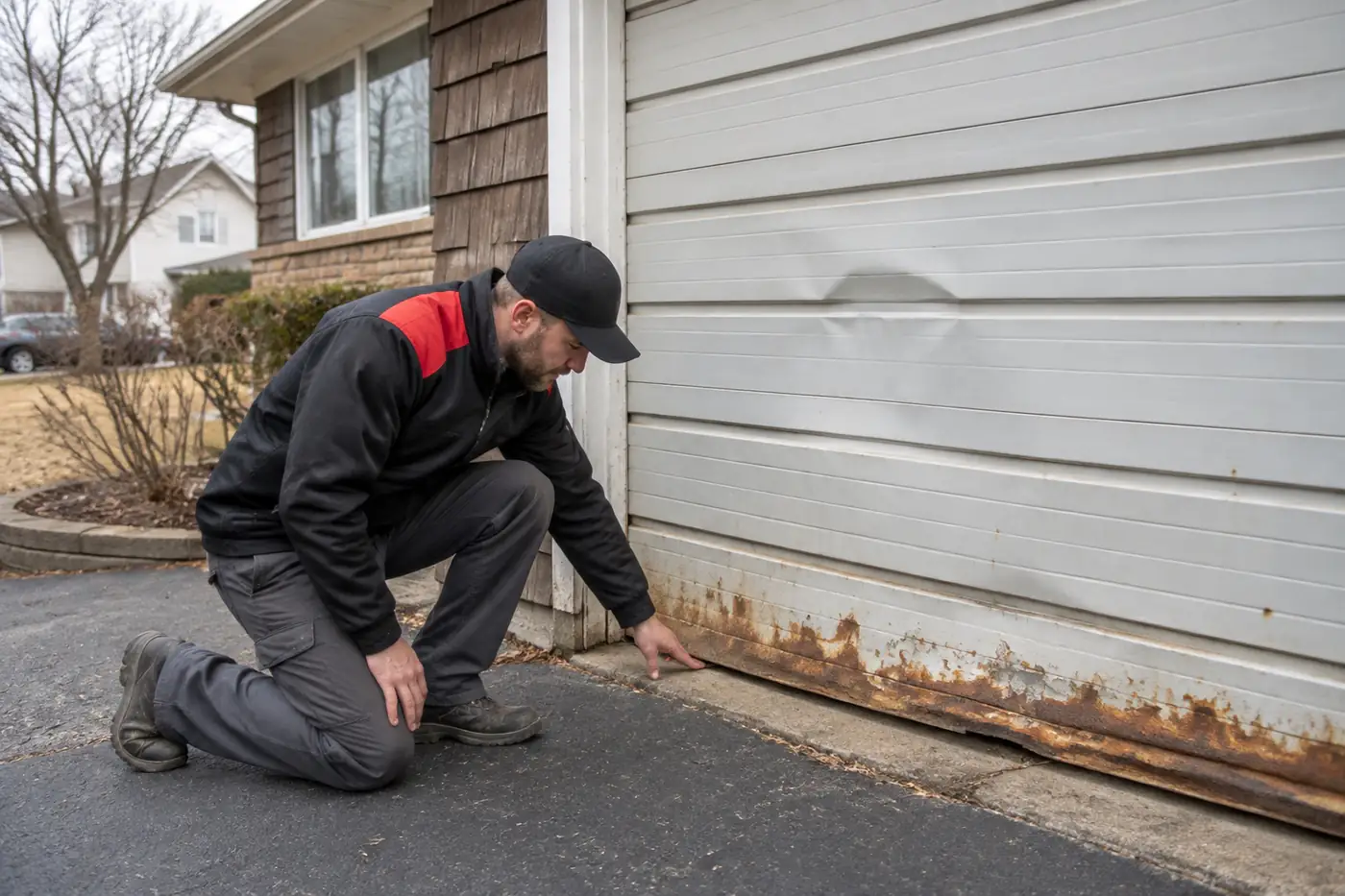
The door itself is the sections, or panels, plus the struts and end stiles that hold them straight. That's where a replacement decision starts. Look at each section inside and out for rust holes, cracks along the hinge lines, skins pulling away from the insulation, rot along the bottom of a wood door, or a section folded by a bumper.
| Problem | Usually repair | Usually replace |
|---|---|---|
| Broken spring or cable | Replace the springs, in pairs on two-spring doors, and the cables | Only if the door is failing too |
| Noisy or worn rollers and hinges | Replace the worn parts | Rarely the reason to replace |
| Opener failure | Repair or replace the opener | The door can stay |
| One dented or cracked section | Replace the section if the model is still made | If it's discontinued or several sections are damaged |
| Rust or rot along the bottom | Treat small spots early | When it spreads across the section or the bottom rail |
| Off-track door after a hit | Often, if the sections aren't badly bent | If panels and struts are kinked |
| Drafty single-layer door | New seals help | If you heat, cool or work in the garage |
What's the average lifespan of a garage door?
So how long do garage doors last? Published ranges run from about 15 to 30 years. Manufacturers put single-layer steel at roughly 15 to 20 years and insulated three-layer steel at 25 to 30, and say well-kept steel and aluminum doors can last up to 30 years. Wood can last a long time too, but only with regular sealing or painting. The National Association of Home Builders' life expectancy study puts openers at 10 to 15 years, so most doors outlive at least one opener.
Where you live matters. Near the ocean and the bays, salt air shortens the life of steel doors and hardware, and a door facing the weather wears faster than one under a deep overhang. Our shore homes guide covers what salt air does and how to slow it down.
Is it cheaper to repair or replace a garage door?
Repair is almost always cheaper up front, and for hardware problems it's the right call. A spring, cable, roller or opener repair costs a fraction of a new door. Our garage door repair cost guide lays out typical ranges by type of repair.
The math flips with section damage on an older door. If two or three sections need replacing, the model is discontinued, or the door needs springs, rollers and an opener all at once, the repair total can approach the price of a new door that comes with all new hardware. A useful rule of thumb: once a repair quote approaches half the cost of a replacement and the door is past about 15 years old, get a replacement price too.
A new door also pays some of its cost back. The 2025 Cost vs Value report, published online by the Journal of Light Construction, put the national average garage door replacement at $4,672 with $12,507 in added resale value, about 268 percent of cost recouped and the top project in the report. In its Middle Atlantic region, which covers cities in New York and Pennsylvania, the figure was about 337 percent. Your price depends on the door you pick; see our garage door installation cost guide, and know that Alpha Pro gives a written price onsite before any work begins.
When should a garage door be replaced?
Any one of these signs can justify garage door replacement. Two or more usually make the decision for you.
- Rust through the steel, not just surface rust, especially along the bottom section and the struts.
- Several damaged sections, or one damaged section on a model that's no longer made.
- Rot, splitting or peeling skins on a wood or composite-faced door.
- Bent or cracked struts and stiles that keep the door from staying straight and balanced.
- No parts available, which is common with old one-piece doors and discontinued hardware.
- Energy loss you notice, like a cold bedroom over a single-layer, uninsulated door.
- A look you want to change before selling, given how much resale value a new door adds.
Repairs that extend a door's life
If the door is sound, a few repairs keep it going for years: new springs sized to the door's actual weight, nylon rollers, fresh cables, a new bottom seal, and a replacement section if the manufacturer still makes your model. Our garage door panel replacement service matches sections where possible, and garage door repair covers everything else. Every visit ends with a balance check and an auto-reverse safety test, so you know where the door stands.
See both prices before you decide
The fairest way to decide is with both numbers side by side. Our technician inspects the door, shows you which parts are worn and which are sound, and gives you a written price for the repair. If replacement makes sense, we'll estimate a new door on the same visit, and estimates are free with no obligation. Nothing starts until you approve it.
You can book a visit online in a two-hour arrival window, or read about garage door installation to see what a replacement involves, from measuring the opening to the final safety test.
Questions people ask
What's the average lifespan of a garage door?
About 15 to 30 years, depending on material and construction. Single-layer steel tends toward 15 to 20 years and insulated three-layer steel toward 25 to 30, while salt air, heavy use and skipped maintenance shorten any door's life.
Is it cheaper to repair or replace a garage door?
Repair is cheaper for springs, cables, rollers, openers and single sections. Replacement starts to make sense when several sections are damaged, parts are discontinued, or an older door needs many repairs at once.
When should a garage door be replaced?
Replace it when the steel is rusted through, several sections are cracked or dented, wood is rotting, or parts for the model are no longer available. A new door is also worth it if you want insulation or better curb appeal before selling.
Can I replace just one garage door panel?
Often you can, if the manufacturer still makes that model and color. Older or discontinued doors may not have matching sections, and a mismatched panel can look out of place, so we check availability before quoting.
Does a new garage door add value to a house?
It tends to. In the 2025 Cost vs Value report, garage door replacement recouped about 268 percent of its cost at resale nationally, the highest of the projects studied. Results vary by market and by the door you choose.
Rather have it handled?
Our technicians handle new garage doors across Jackson, Ocean County and Monmouth County, with a written price before any work starts.
Sources
- blog.amarr.com/average-lifespan-of-a-garage-door-do-i-need-a-new-garage-door
- clopaydoor.com/residential/buyingguide/how-to-choose-the-right-garage-door-material
- standards.nsf.org/higherlogic/ws/public/download/348/NAHB%202007%20StudyUseful%20Life%20of%20Home%20Components.pdf
- jlconline.com/cost-vs-value/2025/national/
- jlconline.com/cost-vs-value/2025/middle-atlantic/
- clopaydoor.com/blog/post/blog/2025/09/24/garage-door-replacement-top-ROI-in-cost-vs-value-report